
Project financed by
National Science Centre, Poland
III-V Quantum Dots on Silicon
Fast exchange and processing of data streams constitutes the core of modern society, called for that reason an information society. The majority of communication is currently carried over optical channels, with light impulses serving as bits of information. A network of optical fibres connect continents, countries, cities and single households. However, the ever growing need for the increase in speed of data transfer and processing requires a next technological step – replacement of electric links between individual computers or computer components, like e.g. memory buses, with optical interconnects; or even a complete substitution of electronic devices with photonic counterparts, where photons replace electrons as information carriers. Although photonic integrated circuits, i.e. crucial components of photonic devices, based on various material solutions, are already available, the real revolution requires technology that would be cost-effective and allow for mass production. To satisfy that condition it is necessary to exploit technology compatible with the silicon based complementary metal–oxide–semiconductor manufacturing platform, currently used for integrated electronic devices, such as processors. However, the nature of silicon poses here a considerable challenge – due to its indirect bandgap it is very difficult to force silicon to emit light. Therefore, it is necessary to include other semiconducting material in the device. The best candidates are quantum dots formed of III-V elements, such as InAs/GaAs or InAs/InP.
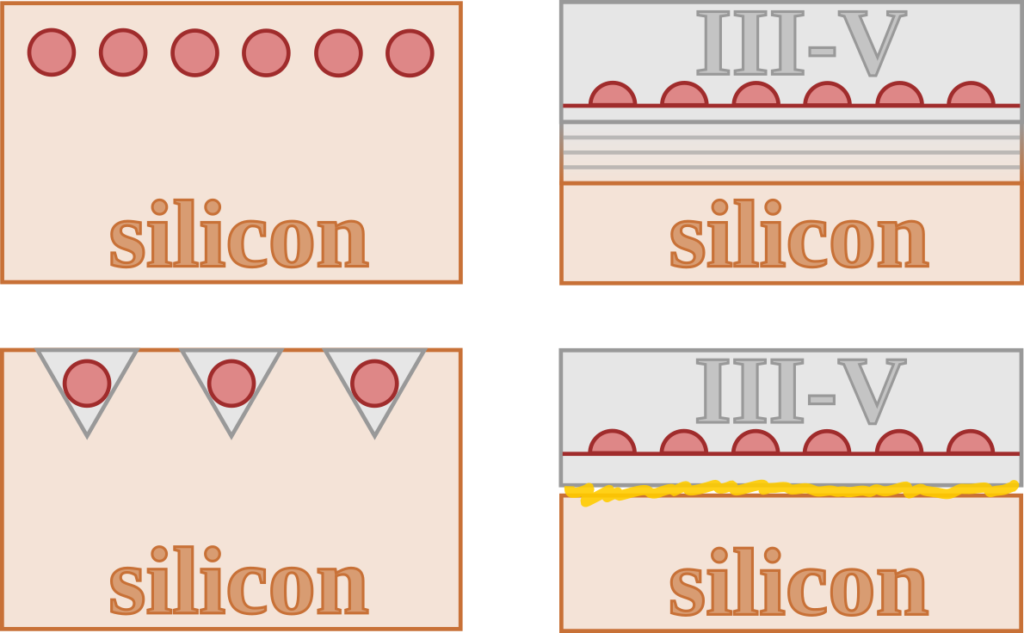
In order to keep reasonable cost of the device, the fabrication process must be monolithical, i.e. without additional bonding of separately grown parts. Unfortunately, another issues arise – III-V compounds have larger lattice constants than silicon, which introduces strain during growth, leading to poor crystalline quality of structures; there is also a large difference between their thermal expansion coefficient, so when a structure grown at elevated temperatures required for the process cools down, it may crack. Both factors lead to a large number of defects present in the III-V quantum dots on silicon, limiting their light emission efficiency.